Supporting IAB UK’s Retail Media Growth Summit with this thought leadership piece, Tesco Media explores how brands can unlock the next phase of retail media growth through richer customer insight, smarter measurement and more connected commerce experiences
Retail media has grown at pace, yet its role in planning remains constrained. Not because it lacks capability, but because it is still used too late in the process.
Too often, it is treated as a downstream activation. Budgets are set, strategies defined, and retail media is asked to optimise what remains.
This is not a limitation of the ecosystem. It is a limitation of planning.
Retail media is being judged on what it delivers, not on how it is being used. As a result, it continues to be underestimated.
The industry continues to debate where retail media fits. The reality is simpler: it is still being planned as a channel, when it should be informing the entire plan itself.
At its best, retail media is not a line on the media plan. It is infrastructure.
From audiences to moments
One reason for this mismatch is that planning has not kept pace with how customers behave. Shoppers do not exist as fixed audiences. They move between missions and mindsets, often within a single journey. Yet much of planning still relies on static audience definitions.
That changes the question entirely. It is no longer just about who to reach, but when to influence. More specifically, when someone is in a state where they are open to influence. Tesco Media research into customers’ ‘Moving Mindsets’ reveals that people shift between emotional and functional mindsets two-and-a-half times on average per shopping trip. This spans a range of different need-states from in a rush and distracted to seeking reward or shopping for social occasions. Even the most functional of shoppers is open to influence on the most focused on shops.
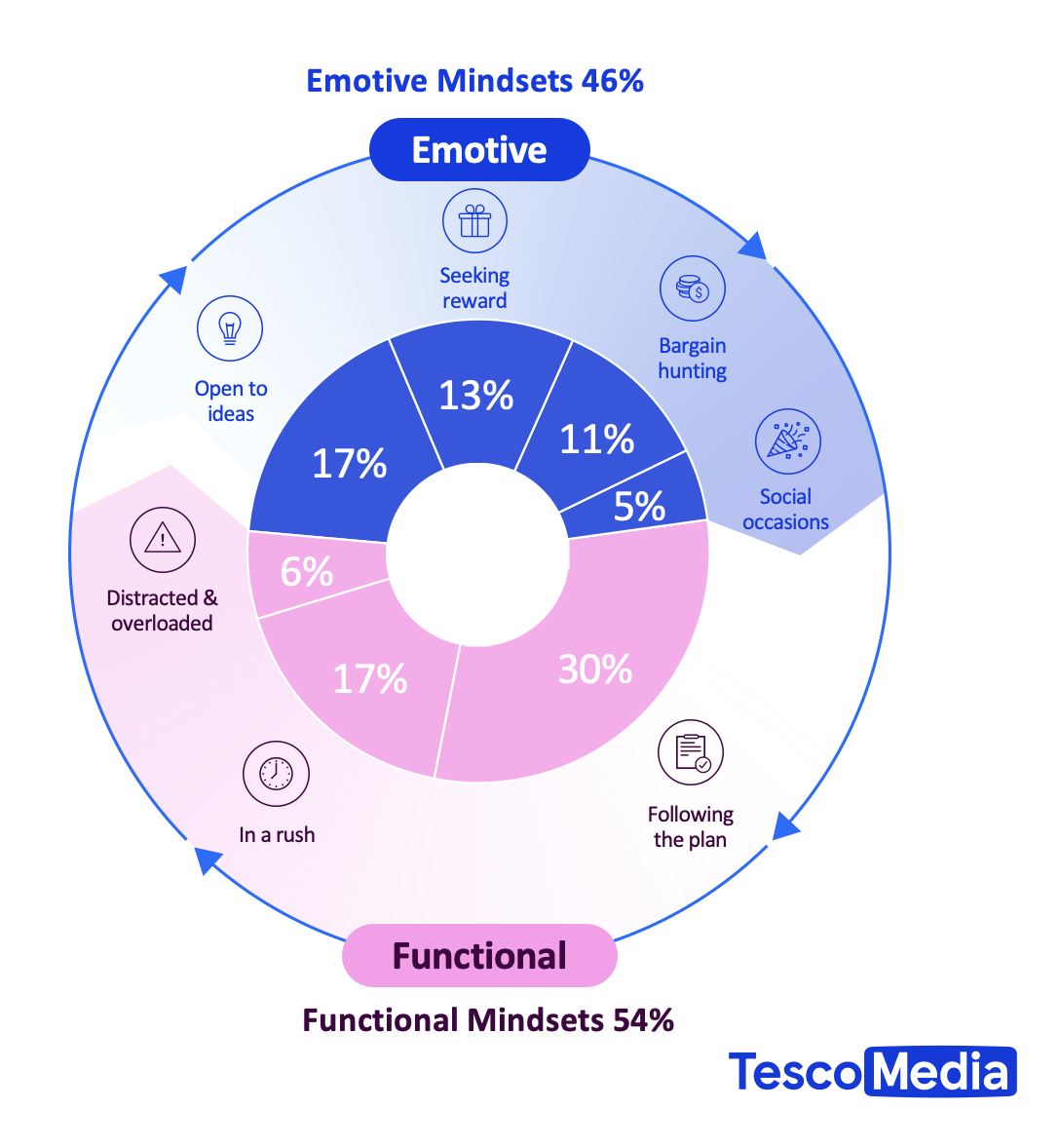
In categories shaped by routine, traditional planning has optimised for reach and frequency, assuming predictable, habitual behaviour. But the reality is far more dynamic and our Moving Mindsets research revealed that only 24% of purchases are purely habitual, leaving the majority of the basket open to change, substitution or discovery.
A more effective approach focuses on moments of disruption where attention increases and decisions become more fluid.
By connecting first-party insight with in-the-moment activation, it enables brands to move beyond targeting towards orchestrating influence, reaching people at scale, at the precise moments they are most open to being inspired.
From silos to orchestration
The more significant constraint, however, is structural.
Media is still planned in silos, yet expected to deliver integrated growth. That disconnect is where much of the potential value is lost. When retail media is introduced late, its role is inherently limited. It can optimise towards end actions, but it cannot shape the path to purchase.
When it is brought in earlier, its role changes materially. It begins to influence how growth is structured, not just how it is executed.
This shift is already visible in practice. In a recent collaboration between Colgate, WPP and Tesco Media, retail media was used to inform the brief from the outset. Planning was grounded in observed buying behaviour from Clubcard data, rather than layered on after the fact and leading to another set of simple pack shots at shelf.
This enabled a shared brief across teams, aligning brand, shopper and commerce objectives earlier in the process. Activities that would typically sit on separate timelines were instead planned together, creating a more cohesive and commercially grounded approach.
The difference was not the tactic. It was when retail media shaped the plan and how it brought different marketers together. At this point, retail media moves from execution to influence, and media planning becomes part of a wider commercial conversation rather than a narrow optimisation exercise.
From media channel to commercial lever
This matters because growth is not driven by media alone. It is created through the interaction of multiple levers, including product, price, promotion and distribution. Retail media sits at the intersection of these decisions.
It provides visibility into who is buying, what they are buying, where and when they are buying, and critically, why they change behaviour. More importantly, it connects those insights to action. Used effectively, retail media can link media investment directly to commercial outcomes, bridging the gap between brand and performance.
However, this only happens when it is planned as part of a broader system.
When media, promotion and distribution are disconnected, impact is diluted. When they are aligned, effects compound. This is where retail media moves beyond advertising and becomes part of a wider commercial engine.
The changing role of the planner
As retail media evolves, so too must the role of the planner. Planning is no longer simply about selecting channels based on fragmented evidence. It is about orchestrating growth, connecting insight, and aligning incentives across teams.
The challenge is not a lack of tools, data or platforms. There will be no single solution that resolves the complexity of modern marketing. The issue is that planning models have not evolved at the same pace as the ecosystem they are attempting to connect.
A new standard for growth
Retail media is already capable of driving both short-term conversion and long-term growth. The constraint is no longer the channel. It is how it is used.
As long as retail media is treated as an add-on, it will behave like one. When it is embedded from the outset, its role changes fundamentally.
The question is no longer whether retail media works.
It is whether planning is ready to catch up.
Posted on: Monday 15 June 2026