The year is 2030. Experiences aren't watched - they're stepped into

Download in-depth slides
IAB UK members can download this new Futurescape chapter, a brand-new addition for 2026 featuring the latest insights.
By 2030, immersive tech adoption is increasingly being shaped by practical value rather than novelty alone. As audiences become more familiar with virtual and spatial experiences, engagement will depend less on spectacle and more on whether the experience feels accessible, intuitive and worth the effort. For brands, that means moving beyond one-off moments of attention and towards environments people actively choose to spend time in because they offer clear usefulness, relevance or reward.
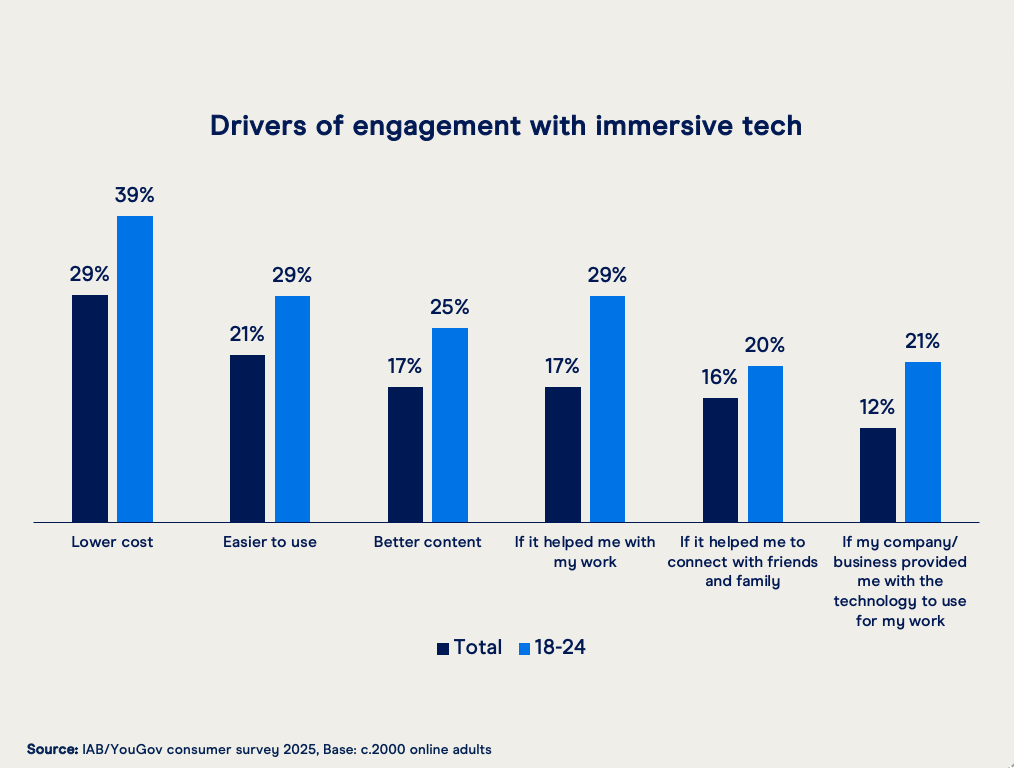
The chart below reinforces that shift. Lower cost, ease of use and better content emerge as the strongest drivers of engagement, with 18–24s consistently over-indexing across each of these factors. Utility also matters: younger audiences are notably more likely to engage when immersive tech helps them with work or makes it easier to connect with others. Together, this suggests that the strongest immersive experiences will be those that remove friction, deliver obvious value and feel embedded in what people already want to do.
“We’re living through a cultural shift as much as a technological one. Consumer expectations are evolving toward simplicity, presence, and personalisation. They want technology that amplifies their humanity rather than replacing it.”
Veronica Parker-Hahn, Director, Global Creative Council, Meta
How to future-proof for 2030
- Build spatial capability now. Organisations need to move beyond flat content and invest early in 3D assets, spatial design and immersive tech. Those who delay will struggle to compete once spatial interfaces become everyday infrastructure.
- Design for utility, not spectacle. Adoption will accelerate when experiences help people do something better, learn faster, shop smarter, or work more safely. Practical value, not novelty, will determine long-term relevance.
- Measure depth, not reach. Success in immersive environments will be defined by time spent, interaction and behavioural impact. not impressions. Brands and platforms must rebuild measurement frameworks around presence and participation.
- Design to be chosen. In immersive spaces, brands win when they operate as environments, services or utilities that users actively opt into, adding value to the experience rather than competing for attention or interrupting it.
- Integrate AI as part of the experience. Static immersive environments will quickly feel outdated. AI-driven personalisation, adaptive spaces and responsive agents will be essential to meeting user expectations by 2030.

Download full chapter
Download this chapter of Futurescape to explore the trends, tensions and opportunities set to redefine advertising, media and consumer behaviour and the strategic shifts brands, media owners and marketers should be preparing for now.