The year is 2030. Brands speak neighbourhood not nationwide

Download in-depth slides
IAB UK members can download this new Futurescape chapter, a brand-new addition for 2026 featuring the latest insights.
By 2030, localism will be less about geography alone and more about context, proximity and belonging. As consumers place greater value on familiar places, trusted voices and community connection, brands will need to move beyond broad national messaging and show up with neighbourhood-level relevance. Local search, postcode-level targeting, retail media and hyper-local creators will all play a bigger role in helping brands connect with people in ways that feel timely, useful and genuinely close to home.
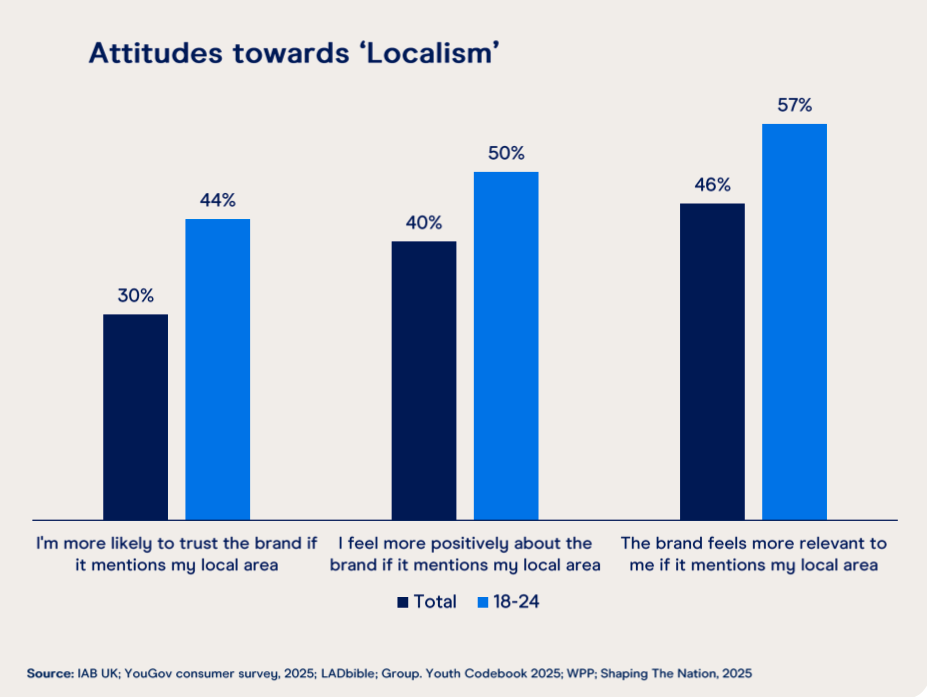
This shift is also about trust. Younger audiences in particular respond strongly to brands that reflect their local area, but only when that relevance feels authentic rather than superficial. The opportunity for advertisers is to combine national scale with local nuance: building flexible campaigns that can adapt by place, moment and community, while measuring success through real local outcomes such as store visits, engagement and postcode-level uplift.
"The opportunities are in working with more diverse groups of people across the country, as the Influencer and Creator market grows nationwide. Opportunities for upcoming brands to take up space by dominating in certain areas, as opposed to casting their net nationwide."
Kitty Newman, Digital Marketing Expert, Trapeze Media
How to future-proof for 2030
-
Design for neighbourhood-level relevance. Brands must plan campaigns assuming local variation as standard. That means building creative, messaging and media that can flex at postcode or neighbourhood level, rather than retrofitting local versions at the end of a national plan.
-
Make retail media and local search your “near-me” engine. Local-intent channels will sit at the heart of real-world discovery. Integrating retail media, “near me” search, maps,
reviews and shoppable formats ensures brands show up exactly where shoppers look first. -
Build creator ecosystems around micro-communities. Trust is shifting to neighbourhood voices and niche creators. Treat micro-creators as always-on partners who bring cultural proximity, authenticity and real influence at street level.
-
Measure real local outcomes, not just reach By 2030, success will hinge on proving local impact, store visits, postcode-level uplift, regional conversion, and community engagement. Brands need measurement frameworks built for local performance, not national averages.
-
Localise dynamically with DOOH and addressable TV. Context-aware DOOH and addressable TV will enable real-time localisation. Brands should use signals like weather, footfall, events or store stock to adapt creative automatically, making every impression locally relevant.
-
Build a privacy-safe, place-based data spine. With third-party data fading,
brands must strengthen their first-party and contextual data rooted in place. Consent-driven local signals build trust, accuracy and long-term resilience in a privacy-first world.
Download full chapter
Download this chapter of Futurescape to explore the trends, tensions and opportunities set to redefine advertising, media and consumer behaviour and the strategic shifts brands, media owners and marketers should be preparing for now.